
Health agenda
How much does knee replacement surgery cost?
Update May 2026 | 5 min read
Expert contributor: Dr Samuel Duff, orthopaedic surgeon
Words by Angela Tufvesson
Key takeaways
- Knee replacement surgery is common in Australia.
- When you have a knee replacement, your damaged knee joint is replaced with a new artificial knee joint.
- Knee replacement is different to knee reconstruction, which repairs damaged structures within the knee.
- People with private health cover in 2023-24 typically paid an average of $1,000 in out-of-pocket costs for specialist fees for a knee replacement.
- After knee replacement surgery, rehab can help you gain flexibility and strength in your new knee.
- HCF offers a range of joint programs to support healthy knees.

Knee replacement surgery can be life-changing, but it’s important to understand the costs. Here’s what you need to know.
Each year, tens of thousands of Australians have knee replacement surgery to relieve pain and restore mobility caused by osteoarthritis or injury. But surgery isn’t always the best solution.
In many cases, symptoms can be improved with non-surgical options. Clinical guidelines recommend starting with education, regular exercise and, where needed, weight management. These approaches are often effective but aren’t always offered – two in three Australians don’t receive this care.
Instead, many people are referred for scans or procedures that may offer little benefit and carry risks. Before considering surgery, talk to your doctor about trying evidence-based lifestyle treatments for knee pain, which may help you avoid unnecessary procedures.
If your healthcare team does recommend knee replacement surgery, there are several ways to have – and pay for – the procedure:
- In a private hospital, where some or all costs may be covered by private health insurance with hospital cover.
- Through the public system, with costs covered by Medicare.
- By paying the full cost yourself in a private hospital without insurance, which can exceed $20,000.
Understanding the costs, wait times and what knee replacement surgery involves is an important first step in deciding whether surgery is right for you, and which option to choose.
What does knee replacement surgery involve?
When you have a knee replacement, your damaged knee joint is replaced with a new artificial knee joint. You might have a partial knee replacement, where only the damaged part of the knee joint is replaced, or full knee replacement surgery, which replaces all surfaces of the knee joint.
Knee replacement surgery can treat severe pain that affects daily life and doesn’t go away with other treatments.
Arthritis Australia recommends talking to your doctor about the possibility of surgery if you have any of the following signs:
- Your pain keeps you awake at night.
- Your pain doesn’t get better with rest, medication, exercise or other treatments.
- Your pain makes it hard to take care of yourself (like showering or getting dressed) and you need help with daily tasks.
- Your condition makes it hard to work or care for others who rely on you.
- Your pain stops you from doing things you enjoy, like exercise or hobbies.
If you’re thinking about having knee replacement surgery, the SMART Choice tool can help you weigh the risks and benefits. Developed from a trial funded by the HCF Research Foundation, it asks a series of questions and uses your answers to show how a total knee replacement could affect your life, based on the experiences of people like you who have had a previous surgery. You can then discuss the results with your doctor to decide what’s right for you.
How much does knee replacement surgery cost in Australia?
While knee replacement surgery can be life-changing, the costs can be significant.
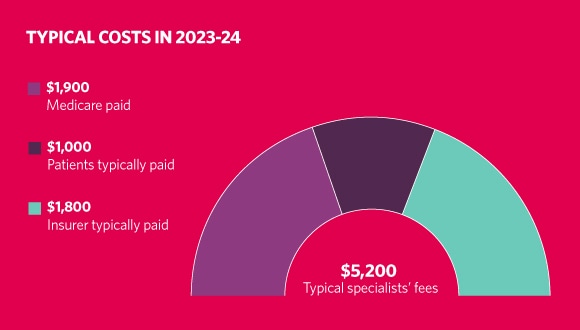
Full or partial knee replacement surgery
People with private health cover who had a knee replacement in a private setting in 2023–24 typically paid about $1,000 in out-of-pocket costs in specialists' fees, (excludes other costs such as hospital charges or excess).
Knee replacement in a public hospital is free, but the waiting time is often the trade-off. In 2024–25, half of all patients on public hospital waiting lists for total knee replacement surgery were admitted within 255 days, while 23% waited more than a year.
Knee replacement rehab
It can take up to nine months to fully heal after knee replacement surgery, orthopaedic surgeon Dr Samuel Duff explains. After surgery, you’ll be given medication to keep pain at a manageable level, and your pain should decrease in the first few days after surgery.
Over the longer term, an exercise and physiotherapy program will help you gain flexibility and strength in your new knee.
- independent exercise at home using a program provided by the hospital physio
- a program designed by a physiotherapist or exercise physiologist who may see you two or three times a week for up to six weeks
- a rehab program that you attend as a day patient at a rehab facility
- a program involving rehab therapists who come to your home
- an in-patient program where you stay in a rehab facility and take part in a multi-disciplinary program for about 10 days.
The cost of these programs varies. In-patient programs are usually more expensive than outpatient or home-based programs. The best option will depend on what’s available in your area, your surgeon’s recommendation and your level of health cover.
Depending on which extras cover you have, you may be able to claim on physio treatments*. Plus, HCF covers a range of private hospital and independent provider rehab programs for eligible members through our No-Gap Joints program^.
How to save on knee replacement surgery costs
Before booking your surgery, check your level of cover to make sure it includes joint replacements, not just joint reconstructions. Knee reconstruction differs from replacement: it repairs and restores damaged structures within the knee, rather than replacing them with artificial parts.
Reduce or avoid gap payments
Use our Find a Provider tool to minimise or avoid gap payments. You can locate participating No-Gap Joints orthopaedic surgeons and hospitals, and find extras providers like physios in our No-Gap network.
Find a participating hospital
We help our members avoid out-of-pocket costs by negotiating charge agreements with private hospitals around Australia. Use the Find a Participating Hospital tool to find a hospital in your area.
Do your research
Our cost indicator tool helps you understand what to expect financially, showing average out-of-pocket costs for common procedures. And with our Preparing for Hospital tool, you’ll have guidance through every step of your procedure, from understanding what’s involved, to expert advice and questions to ask your specialist. Together, these tools help you feel informed, prepared and confident about your healthcare journey.
Knee replacement alternatives to consider
Many people with osteoarthritis try a range of non-surgical options to relieve pain and discomfort, improve movement and possibly delay having a knee replacement. “For most people who have steady progression in their osteoarthritis, it’s important to try the things that have good evidence behind them,” Dr Duff says.
These can include:
- strengthening and aerobic exercises
- weight loss if you’re overweight
- knee taping
- walking with a stick
- topical, oral and injectable medications.
HCF offers eligible members a range of joint health programs to help you manage pain, build strength, move more easily and prevent, delay or prepare for surgery.
Take part in a proven early‑intervention approach to long‑term joint health with the HCF No‑Gap GLA:D® Knees Program, and discover how to better manage knee osteoarthritis symptoms with no out‑of‑pocket costs+.
In addition, the Osteoarthritis Healthy Weight for Life Program provides weight management support**, to help eligible members reduce pain and improve movement in your hips and knees.
Plus, HCF Health Coaching for Knee Osteoarthritis gives you personalised nutrition advice, exercise plans and lifestyle support from experienced health coaches to help you manage knee osteoarthritis at home^^. Start the eligibility survey here.
Reduce out-of-pocket costs for knee replacement surgery
Planning to have knee replacement surgery? Our No-Gap Joints program provides eligible members peace of mind with no out-of-pocket costs (except any hospital excess) from hospital admission through to discharge and post-surgery rehab for primary hip and knee replacements^, with participating private hospitals and clinicians in NSW, Vic and SA.
Related articles
5 exercises to reduce knee pain
These simple exercises can help support your knees, reduce knee pain and increase your sense of balance.
Janet’s knee surgery and recovery
After a fall left Janet in acute pain and needing knee replacement surgery, she discovered the benefits of our No-Gap Joints program.
Why joint pain is worse for women
If your creaky ankles, knees or hips make everyday tasks a challenge, here are some simple ways to ease your joint pain and get your life back on track.
Science-backed pain relief
Everything you need to know about pain and all the options for relief.
IMPORTANT INFORMATION
* Waiting periods and annual limits apply.
^ Eligible members need to have HCF hospital cover including primary hip and knee replacements for 12 months (excluding Overseas Visitors Health Cover). Members must meet clinical criteria and be accepted into the program by a participating clinician and hospital. You may be required to pay a hospital excess, depending on your cover and if you’re claiming for the first time in the calendar year. There may also be some small permitted gaps and additional costs for outpatient appointments, like a visit to your surgeon in their consulting rooms. Program is only available at participating hospitals for a limited time. For full program terms and conditions, including a list of participating hospitals and program end dates, visit hcf.com.au/nogapjoints
+ Eligibility criteria apply. For more information, visit hcf.com.au/joint-health-programs
# To be eligible you must have HCF extras cover that includes physiotherapy, exercise physiology or health management program limits.
** Eligible members must have held HCF hospital cover for 12 months and hospital cover for joint replacement surgery for a minimum of 2 months, have a Body Mass Index (BMI) of 28 and higher, knee or hip osteoarthritis and are considering joint replacement surgery. Excludes Overseas Visitors Health Cover. Clinical eligibility criteria apply. For more information, visit hcf.com.au/hwfl
^^ Eligible members must have held hospital cover for 12 months (excluding Accident Only Basic and Overseas Visitors Health Cover). Clinical eligibility criteria also apply.
This communication contains information which is copyright to The Hospitals Contribution Fund of Australia Limited (HCF). It should not be copied, disclosed or distributed without the authority of HCF. Except as required by law, HCF does not represent, warrant and/or guarantee that this communication is free from errors, virus, interception or interference. All reasonable efforts have been taken to ensure the accuracy of material contained on this website. It’s not intended that this website be comprehensive or render advice. HCF members should rely on authoritative advice they seek from qualified practitioners in the health and medical fields as the information provided on this website is general information only and may not be suitable to individual circumstances or health needs. Please check with your health professional before making any dietary, medical or other health decisions as a result of reading this website.
