
Health agenda
9 health conditions an eye test can help detect
Published March 2026 | 5 min read
Expert contributor: Whitney Lam, Optometry Manager, HCF
Words by Lucy E Cousins
Eye tests can reveal serious conditions like diabetes, high blood pressure or neurological issues. Here’s why you should book one today.
Although our vision is one of our most important senses, a significant number of Aussies delay important eye tests or avoid them altogether. But even if you believe you have perfect vision, HCF Optometry Manager Whitney Lam says that’s not a reason to avoid an eye test.
“First of all, even though you feel you can see perfectly, through an eye test [and any recommendations for glasses or other treatment after the test] we can help your eyes be more relaxed, so they don’t have to work as hard,” she explains. “Secondly, your optometrist can also detect early signs of a range of health conditions during a routine exam.”
"A regular eye test can help identify issues ranging from diabetes to high cholesterol, and support your overall eye health and wellbeing", Whitney adds. "It’s not just about being able to read an eye chart."
It's also important to remember that while an eye test can sometimes detect early signs of broader health issues and the following conditions, it doesn't diagnose medical conditions – so if you have any symptoms or concerns, see your GP.
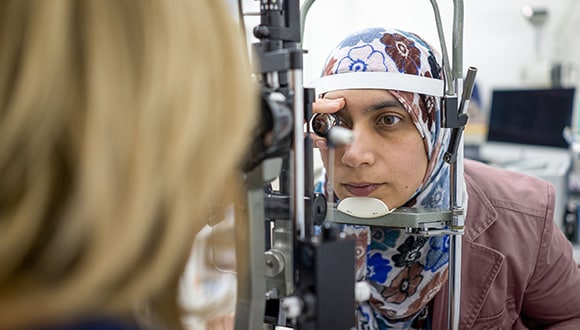
What can an eye test tell you?
In addition to testing your vision and eye strain, an optometrist can look for signs of the following health conditions, says Whitney.
1. Diabetes
While diabetes is linked to symptoms like tingling in the fingers and an increased need to urinate, an optometrist can also pick up on any changes in the eye that might cause patchy or blurred vision.
“Diabetes can show up as little bleeds in the back of the eye,” she explains. “If we see this, we’d advise the patient to see their GP for a comprehensive diagnosis.”
We offer a range of preventative health programs for eligible members* managing heart conditions and diabetes, including phone coaching to support your heart condition and diabetes, and a digital, home-based cardiac prevention program.
2. Multiple sclerosis
A chronic autoimmune disease, multiple sclerosis can affect your eyesight, and it’s often one of the first symptoms patients notice, says Whitney. This condition can lead to symptoms like optic neuritis (sudden loss of vision), double vision and nystagmus (uncontrolled eye movements).
“It’s important to always get an eye test if you’ve experienced any new double vision,” says Whitney.
3. High blood pressure
Hypertension (high blood pressure) can increase the risk of heart disease, stroke and kidney problems. In an eye test, it can show up as bleeds in the eye or the blood vessels starting to curl.
“With high blood pressure, the blood vessels tend to become a bit more tortuous – which means they become more ‘bendy’,” says Whitney.
4. Aneurism
An aneurysm is a blockage in the blood vessels that can be harmless but can become dangerous if it bursts. A few parts of the eye can have an aneurysm, says Whitney, and your optometrist can see the blockage.
“An optometrist can see the blockage in one of the blood vessels inside the eye,” she explains. “But if it happens behind the eye, it might show up as swelling around the optic nerve.”
5. Thyroid eye disease
The thyroid is a gland in your neck that helps control your metabolism, growth, energy and even your body temperature. Some people with thyroid conditions can be affected by thyroid eye disease, says Whitney.
“If you have thyroid eye disease, you might experience swelling, double vision, vision impairment or eye protrusion – where the eyeballs bulge out.”
6. Cardiovascular disease
Cardiovascular disease (CVD), including heart disease, is a major cause of death in Australia, with one in six Aussies living with it. CVD can affect blood vessels in the eyes, causing blurred vision, headaches and sudden vision loss, says Whitney.
“With cardiovascular disease, we might see ‘kinks’ in the blood vessels, and the ratio of thickness between the arteries and the veins might be different to normal or may change over time,” says Whitney.
If you'd like some support to change your lifestyle, The COACH Program® is a four- to six-month phone-coaching support program provided at no extra cost for eligible members^ with heart conditions or diabetes that can help improve your health.
7. Arthritis
Arthritis can lead to various eye conditions, including dry eyes, inflammation and vision loss. In some cases, says Whitney, the medications linked with arthritis can also cause eye disease.
“While optometrists see a lot of people affected by arthritis with dry eyes, we wouldn't necessarily ask a patient who has dry eyes to get checked for arthritis. We may, however, ask someone with dry eyes or a dry mouth to get checked for autoimmune conditions like Sjögren’s disease, which is linked to arthritis."
Similarly, she adds, optometrists check for an inflammatory eye condition called uveitis, which may also be linked to autoimmune disease.
8. Ocular tumours
Ocular tumours can occur in or around the eyes and can either be benign (non-cancerous) or malignant (eye cancer). They can occur on your eyelids and on your eyeball. Some people may even start to notice signs by looking in the mirror, says Whitney.
“Optometrists also look for any freckles on the eyelids which grow in size/shape/height, and also eyelash fallout, which is a concern.”
It’s important to get any symptoms checked, she adds, particularly if you have a family history of cancer.
9. High cholesterol
While cholesterol is essential for many functions within your body, high levels can increase your risk of heart disease. Optometrists can help monitor your eyes for signs of high cholesterol.
“When it comes to cholesterol, a white ring can form in the front, coloured part of the eye [iris] – the outer edge where it meets the white part,” explains Whitney.
If an optometrist notices anything concerning during an eye test, they'll usually recommend you follow-up with a GP for further investigation.
How often should you get your eyes checked?
All babies are checked in hospital at birth and most younger kids are checked in preschool, but parents should continue to check their children’s eyesight every two years, says Whitney.
“If there’s a high risk of myopia – like a family history of short sightedness – the optometrist may recommend a yearly or six-monthly check-up.”
For healthy adults, Whitney says it’s still important to check your eyes every two years, while the official government guidelines suggest Australians over 40 should have an eye test every two to three years (annually if over 65), and more often if they have diabetes, high blood pressure or a family history of eye disease.
Book an eye test
If you’re Sydney-based, our network of HCF Eyecare Centres gives members easy access to high-quality, affordable care. Don’t live near one? You could still get 100% back+ on a range of prescription glasses# and free digital retinal imaging, through our nationwide No-Gap network. Use our Find a Provider tool to find a participating optometrist near you.
Related articles
How eye tests work
To protect your eyesight and maintain good eye health, it’s important to have regular eyesight tests with a qualified optometrist.
Can you prevent short-sightedness?
Short-sightedness is on the rise. Here are ways to manage and even prevent it in both children and adults.
What is macular degeneration?
Find out if you’re at risk of being affected by this eye disease, how it’s diagnosed and how you can lower your risk factors.
Diabetes and your eye health
With an increasing number of Australians diagnosed with diabetes, poor eye health and potential vision loss is becoming an issue for more people.
IMPORTANT INFORMATION
* Eligibility criteria apply. For more information, see hcf.com.au/heart-health-programs
^ Eligibility criteria apply. For more information, see hcf.com.au/coach
+ 100% back at More for You program providers in our No-Gap network is available on selected covers. Waiting periods and annual limits apply. Our No-Gap network of healthcare providers changes often. Please check that your provider is part of our No-Gap network before you book or attend an appointment. See hcf.com.au/100back
# Excludes add-ons like high index material, coatings and tinting.
This communication contains information which is copyright to The Hospitals Contribution Fund of Australia Limited (HCF). It should not be copied, disclosed or distributed without the authority of HCF. Except as required by law, HCF does not represent, warrant and/or guarantee that this communication is free from errors, virus, interception or interference. All reasonable efforts have been taken to ensure the accuracy of material contained on this website. It’s not intended that this website be comprehensive or render advice. HCF members should rely on authoritative advice they seek from qualified practitioners in the health and medical fields as the information provided on this website is general information only and may not be suitable to individual circumstances or health needs. Please check with your health professional before making any dietary, medical or other health decisions as a result of reading this website.
